


You are here
Most Important Stretch For Preventing Low Back Pain
If I could choose just one exercise to do regularly to prevent low back pain, it would be the yoga pose that you see below. This simple pose - often called a form of "Warrior Pose" - combines two actions that I have found to be critical for preventing chronic low back pain.
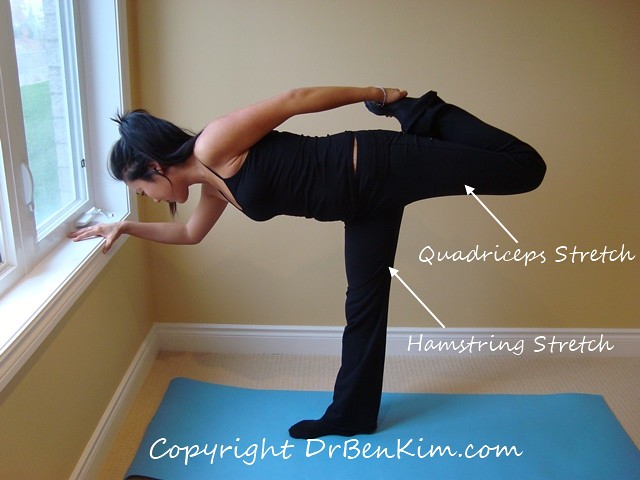
The first action is to stretch your hamstrings. Your hamstrings are the thick muscles that line the back of your thighs. When you do Warrior Pose, the leg that you have rooted on the ground experiences an effective hamstring stretch as your other leg rises behind you.
The second action is to stabilize your core by strengthening your lower back muscles. Warrior Pose requires that you contract your lower back muscles as you bring one of your legs up behind you while keeping your upper body parallel with the ground.
If you find the Warrior Pose difficult to maintain, try doing it while using both of your arms to hold onto a stable surface, like a chair, table, or sofa. Doing this won't take away from the two components of Warrior Pose that are important for low back pain prevention, and will actually allow you to perform Warrior Pose for longer stretches of time.
How long should you maintain Warrior Pose? For as long as you can comfortably maintain it while feeling your hamstrings stretch and your lower back muscles contract. If you haven't been physically active in some time, then I recommend beginning with just a second or two on each leg. As your stamina and physical condition improve, you can work your way up to holding the Warrior Pose for 10-30 seconds at a time on each leg.
How often should you do Warrior Pose? As often as you can without causing an uncomfortable strain in any of your muscles.
While doing Warrior Pose, please remember to maintain steady breathing. An effective way to promote steady breathing while doing any stretch is to make a conscious effort to keep your facial muscles relaxed. As you maintain Warrior Pose while breathing evenly, visualize your hamstrings becoming longer and stronger, and your lower back muscles becoming stronger as well.
If you have a health challenge with one or both of your knees that makes it difficult to do Warrior Pose on a fully straightened bottom leg, you can try this pose with your bottom leg slightly bent (flexed) - this will take some pressure off the surfaces of your knee joint, but won't take too much away from the hamstring stretch and the lower back contraction.
Additional Notes on Exercising and Stretching to Prevent Low Back Pain:
-
To understand why stretching your hamstrings is critical addressing chronic low back pain, view the following article:
-
Many fitness and physical health care experts recommend doing abdominal exercises to strengthen your core trunk region. While I support this recommendation, my experiences have led me to believe that low back strength is just as important as abdominal strength for preventing low back pain. If you can regularly exercise both regions, I encourage you to do so. If you're just looking to do one exercise/stretch to begin with, the Warrior Pose is an excellent choice.
-
Warrior Pose and all other strenuous exercises should be avoided during episodes of acute low back pain. For more information on treating acute low back pain, view: