


You are here
One Stretch That Can Injure Your Lower Back
I've long recommended avoiding vigorous stretching first thing in the morning; the risk of injury is significant, especially as we get older, as our muscles, tendons, and ligaments are not well perfused with blood when we first wake up. These tissues are best stretched after we have been out and about for an hour or two, and optimally, after enough of an aerobic workout where we are sweating - if we've worked hard enough to sweat, we can reasonably assume that our muscles and ligaments are flush with blood and ready to be safely and effectively lengthened through stretching.
One stretch in particular that I have found to be quite dangerous to lower back health is forward bending where your legs are pressed together on the ground in front of you, and you lower your chest to get as close as possible to your knees. Some people use this position to stretch their hamstrings, others to stretch their lower back. Regardless of which muscles you are targeting, you should know that this stretch puts significant pressure on the discs that act as shock absorbers between the vertebrae in your lower spine.
Bending straight forward where your chest approaches your thighs necessitates forward flexion of your lumbar spine, which tends to push your intervertebral discs back toward the lumen that houses your spinal cord, as well as toward the holes on either side of each intervertebral space that allows large bundles of nerves to enter and leave your spinal column.
In a healthy spine, a taut bundle of ligaments line the back of your discs, preventing them from encroaching on the spaces described above - you can thank this brilliant design for allowing you to go about all of your daily activities without getting jolted around every time your discs touch your spinal cord or peripheral nerves.
But like all of the tissues in your body, the ligaments that prevent disc protrusion into the long tunnel that houses your spinal cord and the roots of your peripheral nerves can unravel through repeated injury. And where there is enough unraveling, portions of your disc material can give you the unique and unenviable experience of chronic low back pain and possibly some form of peripheral nerve disease, the most common one being sciatica.
I've treated countless people for chronic lower back disc-related problems over the years, and I can conservatively state that upon questioning, a good percentage of these people were taking their lumbar spine through aggressive forward flexion early in the morning. I get this - for many, the best time to exercise is before work or after one has dropped the children off at school. Early morning fitness and yoga classes are a huge part of our culture, and they do a whole lot of good. The point here is to avoid pure forward flexion of your lumbar spine without being thoroughly warmed up, and if possible, to save aggressive stretching for later on in the day or after a solid aerobic workout.
Generally, the safest way to stretch your hamstrings is to focus on one leg at a time. When you forward flex your trunk toward one leg while the other leg is off to the side or behind you while you are standing (like in the photo below), the discs in your lumbar spine have room to shift toward the side of your "lax" lower extremity, which saves the ligaments that keep your discs in their intended spaces, which preserves all of the holes that house your spinal cord and peripheral nerves - in other words, all of your tissues stay where they should and your body has no need to create an inflammatory response.
Photo of Unilateral Hamstring Stretch Using a Form of Warrior Pose:
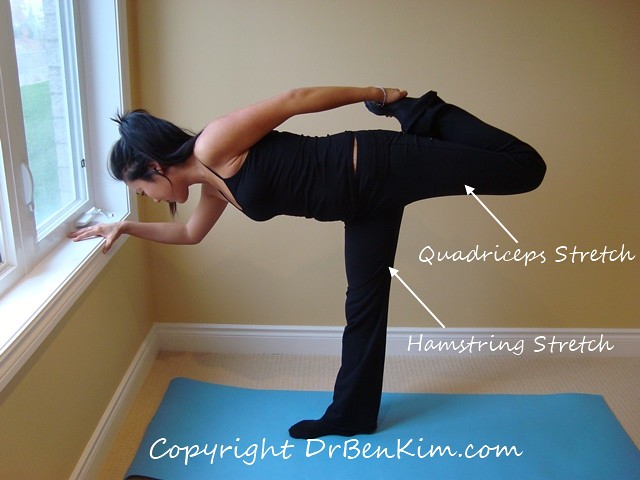
To be clear, in the photo above, it's the hamstring muscle group of the grounded leg that is being stretched. If a hip problem or any other health challenge makes it difficult for you to perform this stretch, you can try stretching one side at a time while sitting on the ground, tucking the opposite foot in against the inner thigh of the leg you are stretching, then pulling gently on both sides of a towel that is hooked around the sole of the foot of your target leg.
Photo Of Unilateral Hamstring Stretch while Sitting:
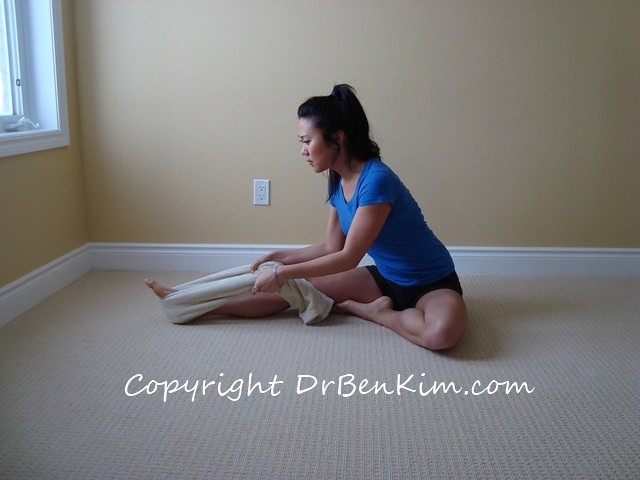
Be sure to keep your lower back stable and straight, as there is no need to forward flex your lumbar spine to effectively stretch your hamstrings. In fact, if you keep your lower back slightly extended (super straight), you'll likely find that you won't have to bend too far forward from your waist to feel an excellent hamstring stretch.
To stretch your lower back region without compromising your discs, try the following side-lying lumbar stretch:
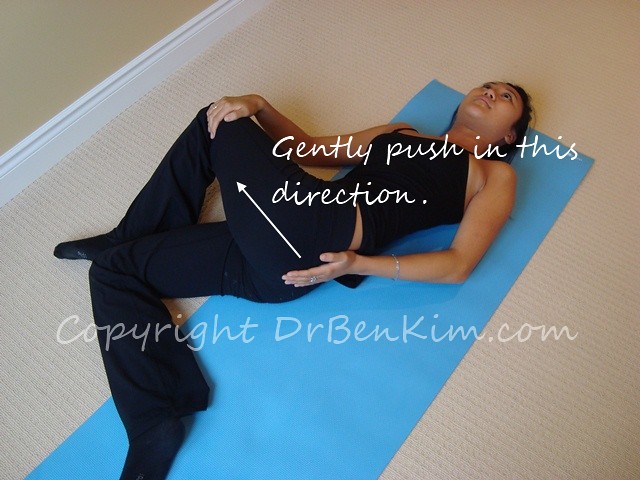
For a step-by-step pictorial that shows you how to safely perform this side-lying low back stretch, have a look at the following post:
Two Gentle Stretches For A Healthy Back
Again, please remember that these and all other stretches are best reserved for after you have been up and about, or at the very least, after enough of an aerobic workout that has stimulated sweating.
If you know anyone who follows an intense stretching program first thing in the morning, please consider passing this post along. As anyone with a herniated lumbar disc will tell you, to do all that you can to prevent chronic low back pain is profoundly wise.